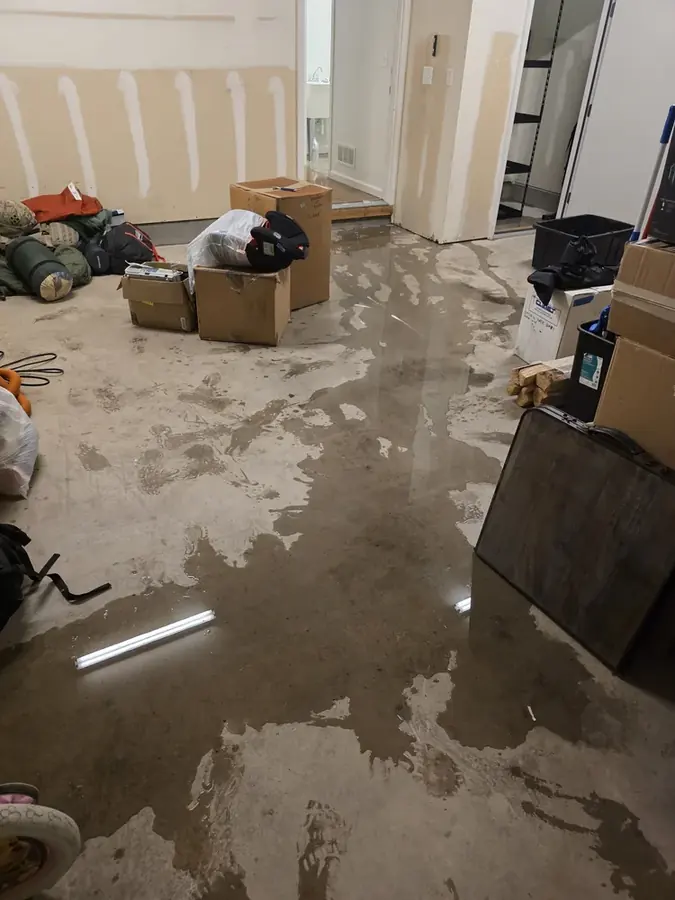
Milwaukee's full basements take water first. Our crews pump out the flood, pull the wet materials, and dry the space to a verified standard before it turns to mold.
In Milwaukee, the basement is where water goes first. Around 85 percent of homes here have one, and it sits at the lowest point of the house, so a storm, a spring melt, a failed pump, or a backed-up drain all end up down there. Standing water in a basement is a race against wicking and mold, and the sooner we pump it out and start drying, the more of your lower level we save.
Why Milwaukee basements flood
A flooded basement almost always traces back to one of a few sources, and knowing which one matters because the fix differs:
A single sump pump that quit or lost power in a storm, covered on our sump-pump failure page
Heavy rain overwhelming the drains and backing up a floor drain
An old stone or block foundation seeping under pressure, see foundation seepage
A burst supply line upstairs draining down to the lowest floor
If the water is a sewer or drain backup, it is Category 3 black water and needs the extra steps on our sewage cleanup page. The EPA guidance on managing stormwater explains why so much rain ends up below grade.
What to do while we roll
Your safety comes first, because a wet basement often has live outlets and a running furnace:
Do not walk into standing water if it is near outlets or the panel
Shut off power to the basement only if you can reach the breaker safely and dry
Note how high the water rose so we can map the wicking line
Do not use a household vacuum on the water
Call and we bring truck-mounted and submersible pumps to clear the water fast, then start the drying the same visit.
Water standing in your basement right now? Call and a Milwaukee crew with pumps is on the way, 45 to 90 minutes out, day or night.
We pump out the standing water, then pull the materials that hold it: wet carpet and pad, soaked drywall to above the water line, and saturated insulation. We disinfect the slab, set air movers and commercial dehumidifiers, and dry the block, framing, and subfloor to a measured target while we monitor daily. We document everything for your claim and, where a failed pump or a seeping wall caused it, we lay out how to keep it from happening again.
"Our sump pump quit during a downpour and the basement took a few inches overnight. They pumped it out, pulled the wet pad, and had dehumidifiers running that same evening. Five days later the readings were normal."
Curtis D. · Washington Heights
How it works
How we handle basement flooding cleanup in Milwaukee
1
Call & dispatch
A dispatcher answers 24/7 and the nearest Milwaukee crew rolls with truck-mounted pumps, air movers, and moisture meters.
2
Find the source & the reach
We stop the water at the source and map how far it spread, including what soaked into subfloor, block, and wall cavities.
3
Extract & dry
We pull the standing water, then run air movers and dehumidifiers to a verified dry standard, not just the surface.
4
Verify & bill
We log moisture readings until the structure is dry, then document the loss and bill your carrier directly.
Cost
What does basement flooding cleanup cost in Milwaukee, WI?
In Milwaukee, WI, basement flooding cleanup usually runs $2,000 to $7,500, depending on the depth of water, whether the basement is finished, and the water category. An unfinished basement with clean water is at the low end; a finished lower level or a sewer backup is at the high end.
See a fuller range with our water damage cost calculator. Most water damage is covered by insurance, and we bill your carrier directly.
Water damage in Milwaukee or Milwaukee County? Call (414) 895-6813, 24/7.
Service area
We cover every Milwaukee neighborhood
1521 N Jefferson St, Milwaukee, WI 53202
Seated downtown at 1521 N Jefferson St, our crews reach the East Side, Bay View, Riverwest, Sherman Park, Washington Heights, Walker's Point, and every corner of Milwaukee County, day or night, most homes in 45 to 90 minutes.
We answer 24/7 and reach most Milwaukee homes in 45 to 90 minutes with truck-mounted and submersible pumps. The sooner we start, the less water wicks into block, framing, and subfloor.
Is basement flooding covered by insurance?
It depends on the source. A sudden failure like a burst pipe or an appliance line is usually covered, while surface flooding and sewer backup are often separate riders. We document the source and loss and bill your carrier directly for what is covered.
Can you save my finished basement?
Often yes, if we start fast. We dry framing and subfloor in place where we can and only remove what cannot be dried, like soaked pad and drywall below the water line. Quick extraction is what saves the most.
Why does my basement flood every heavy rain?
Usually a single sump pump that cannot keep up, a floor drain that backs up, or an old foundation wall that seeps under pressure. We find which one it is and, once it is dry, lay out the fix so it stops recurring.
Do I need to worry about mold after a basement flood?
Standing water that sits will start mold within a day or two, which is exactly why we dry to a verified target instead of just pumping and leaving. Fast, complete drying is the best defense.
24/7 emergency dispatch
Milwaukee's water damage crew is standing by
Water sitting means damage spreading. Call Milwaukee Foundation & Waterproofing and a local crew is on the way, 45 to 90 minutes out.